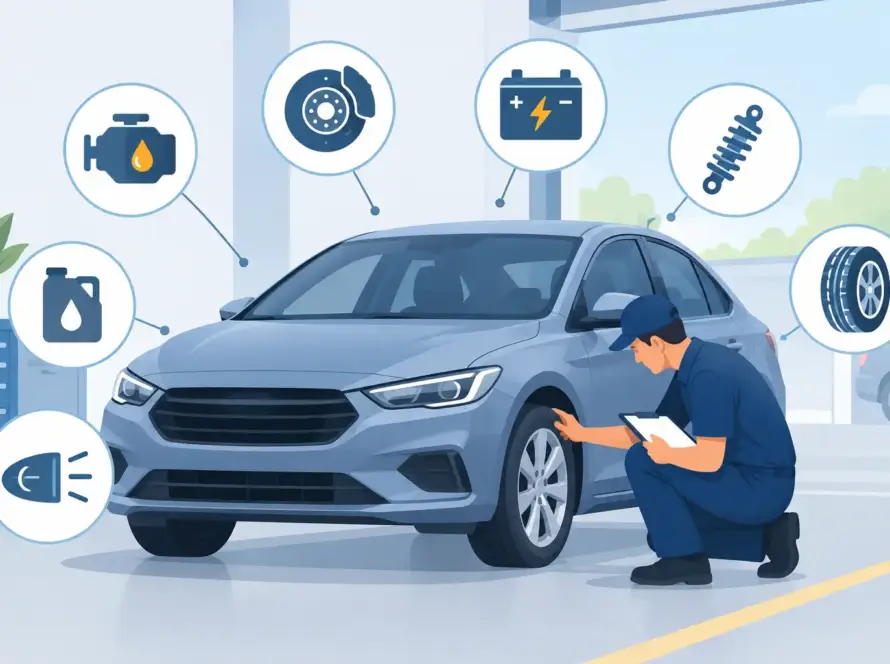
A used car can feel perfect during a short drive, yet its computer may be recording problems the seller never mentioned. An OBD diagnostic scan gives a buyer access to that electronic side of the vehicle, checking for fault codes, warning-light history, and system data that can point to developing trouble.
That matters when you are about to commit serious money to a car in the UAE. But a scan is not a magic pass-or-fail button. A clean result does not prove a vehicle is healthy, and a fault code does not automatically mean you should walk away. The value is in understanding what the car is reporting, what may have been hidden, and whether the findings match its condition, service history, and road-test behavior.
What an OBD Diagnostic Scan Actually Does
OBD stands for On-Board Diagnostics. Most modern vehicles have a diagnostic port, usually located beneath the dashboard near the driver’s seat. An inspector connects a professional scan tool to communicate with the vehicle’s control modules.
The engine computer is the system most people associate with a scan. It monitors items such as ignition performance, fuel delivery, emissions equipment, sensors, air intake, cooling operation, and transmission-related signals. When it detects a reading outside its expected range, it may store a diagnostic trouble code. In some cases, it turns on the check-engine light.
On many vehicles, a capable scan tool can go much further than engine codes. Depending on the make, model, and equipment level, it may communicate with the transmission, ABS and stability-control system, airbags, body-control module, climate-control system, parking sensors, cameras, infotainment system, and electronic suspension. Hybrid and electric vehicles can also provide battery, charging, thermal-management, and high-voltage-system information.
The result is not merely a list of code numbers. A meaningful inspection interprets the codes in context. An oxygen-sensor code, for example, can be caused by the sensor itself, but it can also relate to an intake leak, wiring problem, exhaust leak, fuel-mixture issue, or an engine fault. Replacing parts based on a code alone is how money gets wasted.
Why a Scan Matters Before Buying a Used Car
A seller may say, “There are no warning lights.” That is useful information, but it is not the same as proof that no faults exist. Some faults are stored as pending codes before a warning light appears. Others may be intermittent, meaning the issue occurs only under certain temperatures, speeds, or driving conditions.
A diagnostic scan can also reveal whether the vehicle’s emissions readiness monitors are complete. These monitors are self-tests the car runs after it has been driven through normal operating conditions. If several monitors show “not ready,” it may mean the battery was recently disconnected or fault codes were recently cleared.
That does not always indicate dishonesty. A dead battery, recent repair, or routine maintenance can reset readiness data. Still, it is a valid reason to ask questions. If a seller cleared the check-engine light shortly before viewing the car, the warning may return after a few days of driving. Buyers should not be pressured into accepting “just drive it and see” after payment has been made.
For vehicles with advanced safety systems, the scan becomes even more valuable. An airbag warning, ABS fault, communication error, or sensor calibration issue can be expensive to diagnose properly. On premium cars, a single electronic module or suspension component can materially change the real cost of ownership.
What Fault Codes Can Tell You
Diagnostic trouble codes are clues, not repair invoices. They generally fall into three useful categories during a pre-purchase inspection.
Current or active codes indicate a fault the vehicle is detecting now. These deserve immediate attention, especially when they relate to engine misfires, overheating, oil pressure, transmission operation, airbags, brakes, or stability control.
Pending codes indicate a condition the vehicle has detected but has not yet confirmed enough times to illuminate a warning light. A pending misfire or catalyst-efficiency code should not be dismissed simply because the dashboard is clear. It may be the beginning of a larger issue.
Stored or history codes show faults recorded in the past. Some may relate to a resolved repair, while others can reveal a repeating problem. The key question is whether the code has returned, whether supporting data points to an unresolved cause, and whether the seller has documentation for the repair.
A good scan can also provide freeze-frame data for certain engine faults. This records conditions present when the code was set, such as engine speed, coolant temperature, vehicle speed, and fuel-trim readings. That context can help distinguish a one-time event from a fault that occurred during normal driving.
A Clean Scan Does Not Mean a Clean Car
This is where buyers can make a costly mistake. A vehicle can show no major codes and still have accident damage, worn suspension, oil leaks, weak air conditioning, underbody damage, tired tires, brake wear, poor-quality repairs, or signs of flood exposure. A scan tool cannot measure paint thickness, inspect chassis alignment, hear a wheel bearing, or identify a rough transmission shift during a road test.
It also cannot reliably confirm the accuracy of an odometer reading on every vehicle. Some modules may retain mileage information, but access and reliability vary by manufacturer. Mileage verification should be considered alongside service records, vehicle-history checks, wear patterns, and the overall condition of the interior and mechanical components.
There is another limitation: codes can be erased. Clearing codes removes the visible record from many systems, at least temporarily. A basic code reader may then show no faults, which is why readiness-monitor status and a full physical inspection matter. A seller can reset a computer in minutes. They cannot as easily hide fresh oil leaks, uneven tire wear, chassis repairs, or the behavior of a vehicle during an extended road test.
Why Professional Interpretation Makes the Difference
A low-cost reader can retrieve generic engine codes, and it can be useful for a quick initial check. However, it often cannot access every module, manufacturer-specific code, live-data value, or system test needed to understand a modern vehicle properly.
More importantly, the person reading the result needs to know what to investigate next. A transmission-related code should be considered alongside fluid condition, shift quality, road-test behavior, maintenance history, and any signs of previous repair. A battery-voltage code may be a simple aging battery, but it can also point to charging-system problems or electrical issues caused by poor repair work.
This is why an OBD scan should be part of a complete pre-purchase inspection rather than a stand-alone service. At CarChecker.ae, computer diagnostics are assessed alongside the engine, transmission, brakes, chassis, underbody, exterior, interior, maintenance evidence, and a road test where conditions allow. We are on your side, not there to repeat the seller’s description of the car.
When a Code Should Change Your Decision
Not every fault needs to end the purchase. A minor sensor issue with a clear diagnosis, a reasonable repair estimate, and no wider symptoms may simply give you room to negotiate. The decision depends on the vehicle’s price, age, mileage, service history, and the type of car you are buying.
The risk rises when there are multiple unrelated codes, repeated misfires, transmission faults, airbag or ABS warnings, overheating concerns, network communication errors, or evidence that codes were recently cleared. The same applies when the seller cannot explain the issue, refuses an independent inspection, or insists you decide immediately.
For a luxury, performance, hybrid, or electric vehicle, be especially careful with system warnings. Specialized repairs can be expensive, and a low purchase price can quickly lose its appeal if the car needs major electronic, battery, suspension, or drivetrain work. Inspect before you invest.
Before you hand over a deposit, make sure the scan results are read alongside the vehicle itself. The most useful finding is not always a dramatic fault code. Sometimes it is the small inconsistency that gives you the confidence to ask the right question, negotiate fairly, or choose a better car.