A shiny paint finish, a clean cabin, and a seller saying “no issues” can make a used car look like an easy decision. But what does a proper CarChecker.ae inspection include when it is done to protect the buyer rather than simply move a sale forward? It should go far beyond a quick walk-around or a scan for dashboard warning lights.
A proper pre-purchase inspection looks for the problems that are expensive, unsafe, or easy to hide: prior collision repairs, fluid leaks, worn suspension parts, engine concerns, electronic faults, poor maintenance, and evidence that the vehicle’s history does not match the seller’s story. For UAE buyers, it also needs to account for heat, heavy air-conditioning use, desert exposure, and the fact that cars frequently move between emirates.
What does a CarChecker.ae inspection include?
A basic visual check may identify obvious body damage and worn tires but miss several serious issues or hidden defects. A CarChecker.ae inspection evaluates the vehicle as a complete system, combining physical checks, computer diagnostics, documentation review, underbody assessment, and a road test where conditions allow. Most importantly, its OUR inspector doing it, the best in the business.
The purpose is not to promise that no future repair will ever be needed. Every used vehicle has wear, and even well-maintained cars can develop faults later. The goal is to reveal the vehicle’s present condition clearly enough for you to decide whether to buy, negotiate, ask for repairs, or walk away.
Exterior, bodywork, and structural checks
The exterior is where an experienced inspector can often find clues that a casual buyer misses. Paint thickness readings, panel gaps, mismatched paint tones, overspray, uneven finishes, and replacement fasteners may point to previous repair work. A repaired panel is not automatically a deal-breaker, but it matters whether the repair was cosmetic or connected to meaningful accident damage.
Our Inspection also covers checking the windshield, windows, lights, mirrors, door operation, locks, trim, wheel condition, and tires. Tire checks include tread depth, age, sidewall condition, and uneven wear patterns. Uneven wear can indicate alignment trouble, worn suspension components, or previous impact damage.
A thorough structural assessment examines accessible chassis areas, mounting points, radiator supports, aprons, floor sections, and signs of welding, straightening, corrosion, or non-factory sealant. This matters especially on vehicles described as “accident-free.” A car can look excellent from the outside while carrying evidence of a significant repair underneath.
Engine, transmission, and mechanical condition
The mechanical part of the inspection focuses on whether the major systems operate correctly and whether there are signs of developing failure. Inspectors look for leaks around the engine, transmission, cooling system, steering system, and differential where applicable. They assess belts, hoses, battery condition, fluid levels and condition, cooling components, and visible engine bay repairs.
The engine is checked for abnormal noises, rough running, smoke, vibration, overheating concerns, and response under acceleration. Transmission assessment includes shift quality, hesitation, slipping, harsh engagement, and unusual noises. On four-wheel-drive vehicles and SUVs, the inspection should also consider transfer case operation, driveshafts, differentials, lockers, sway bar disconnects, Offroad drive modes and drivetrain behavior.
Suspension, steering, and brakes deserve the same attention. Worn bushings, ball joints, shocks, wheel bearings, brake discs, pads, calipers, and steering components can turn an apparently affordable purchase into an immediate repair bill. Some wear is normal for the vehicle’s age and mileage. The important question is whether a repair is routine maintenance, urgent safety work, or a sign of broader neglect.
Computer diagnostics and electrical systems
Modern vehicles store valuable evidence in their control modules. Computer diagnostics can identify current fault codes, pending faults, sensor issues, module communication problems, and warning systems that may have been reset before a viewing. A clean dashboard alone does not prove the car has no faults.
Diagnostics should be considered alongside the physical inspection. A code can be intermittent, historical, or caused by a minor issue, while a serious mechanical concern may not generate a code at all. The value comes from interpreting the scan results in context rather than treating any single warning as an automatic verdict.
The electrical inspection also checks practical buyer essentials: windows, central locking, infotainment, cameras, parking sensors, lighting, seat controls, sunroof operation, climate controls, and charging ports where fitted. In the UAE, air conditioning is not a comfort extra. Weak cooling, inconsistent vent temperatures, compressor noise, or poor blower performance can be a major ownership concern.
Interior condition and safety equipment
The cabin can reveal how a vehicle was used and cared for. Inspectors assess seat wear, upholstery, dashboard condition, water damage indicators, odors, switches, gauges, warning lights, and signs of poor repairs. Excessive wear that does not match the displayed mileage deserves closer attention.
Safety checks include accessible seat belts, airbags and airbag warning lights, horn operation, tire-pressure warnings, and driver-assistance features where equipped. An airbag light that stays illuminated, or one that fails to illuminate briefly during startup, requires investigation. Safety systems are not areas for guesswork or seller assurances.
Underbody inspection and a road test
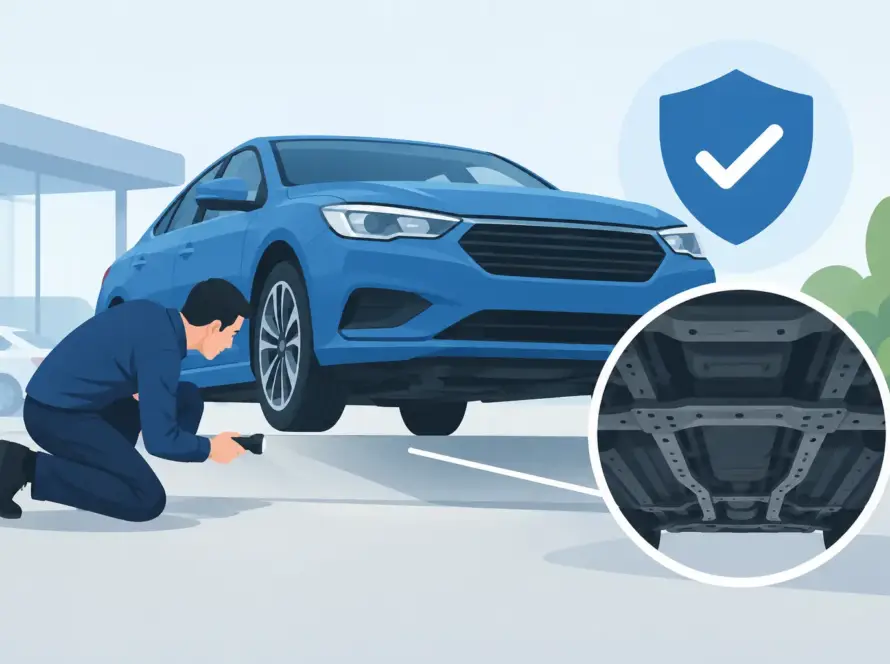
An underbody inspection is one of the clearest ways to understand what a car has been through. It can expose oil leaks, damaged splash shields, bent components, corrosion, exhaust damage, previous repairs, and impact marks that cannot be seen from above. This is particularly useful for vehicles that have been driven off-road, over curbs, or through standing water.
A road test brings the static inspection to life. The inspector listens and feels for engine hesitation, transmission behavior, brake performance, steering pull, vibration, suspension noise, wheel bearing hum, and overheating. Different speeds and driving conditions can reveal problems that do not appear when the car is parked.
A road test is sometimes limited by the seller’s permission, registration status, insurance, location, or traffic conditions. If it cannot be completed, that limitation should be clearly documented. No inspection should imply that a test was performed when it was not.
Maintenance records and vehicle history
The physical condition tells one part of the story. Maintenance records and vehicle history add context. Service invoices may show whether oil changes, brake work, cooling-system repairs, and major services were completed on schedule. Gaps in records do not always mean the car was neglected, but they increase uncertainty.
A history assessment can help identify mileage discrepancies, previous damage records, import status, salvage concerns, and other ownership details. This is especially relevant when buying a vehicle brought into the UAE from another market. Specifications, accident history, repair standards, and warranty eligibility can vary considerably.
For electric vehicles, the scope should also include battery health indicators, charging-system operation, high-voltage warnings, thermal-management behavior, charging-port condition, and EV-specific diagnostic results. An EV may drive smoothly while still carrying battery or charging concerns that are costly to address.
What you receive after the inspection matters
An inspection is only as useful as its report. You need findings that are organized, explained in plain language, and supported by photos or video where appropriate. The report should separate safety concerns and urgent repairs from normal wear, cosmetic items, and maintenance to plan for later.
That distinction helps you act. A scratched bumper may be a negotiation point. A structural concern, overheating evidence, transmission fault, or airbag issue may be a reason to stop the purchase entirely. CarChecker.ae brings that independent assessment to the vehicle’s location, so buyers can make the decision with evidence rather than pressure.
Before you transfer a deposit or sign a sale agreement, let us give the car the chance to tell its real story. The car is speaking to us and we understand exactly what it’s saying. The right inspection does not just identify faults – it gives you the confidence to buy on your terms, or the clarity to leave a risky deal behind.