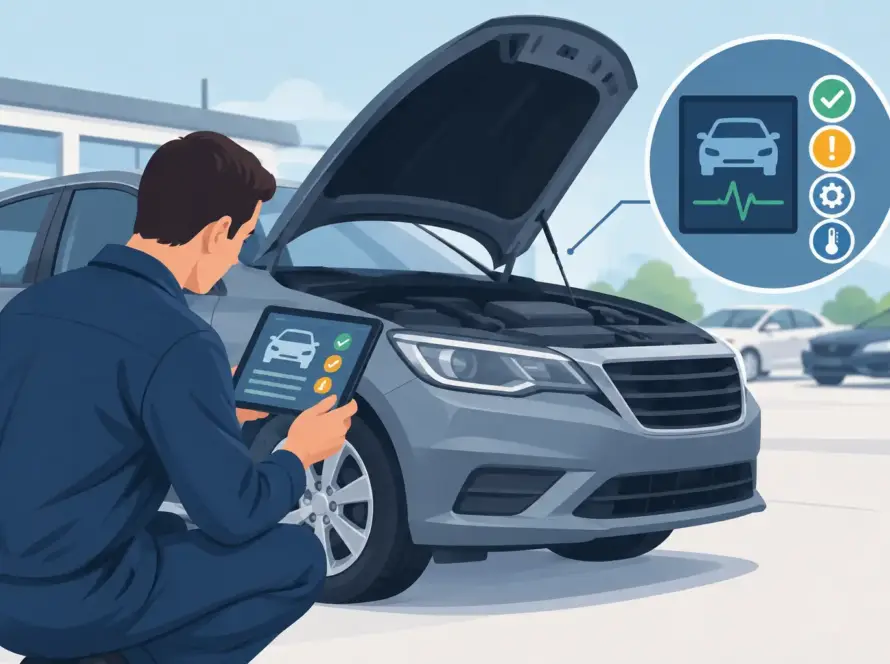
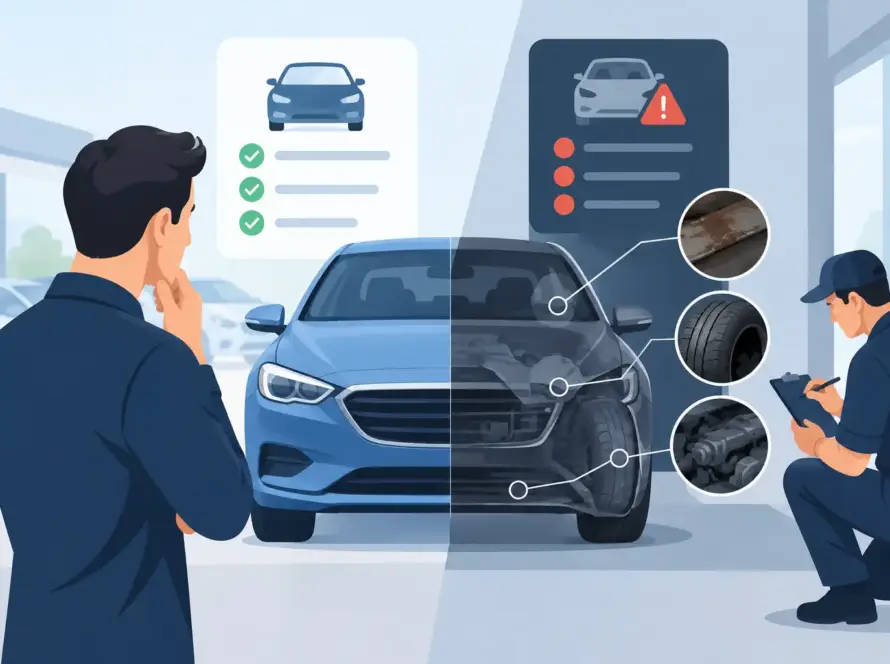
A used car can look spotless under Dubai sunlight and still carry the consequences of an undisclosed accident repair. Fresh paint, a detailed interior, and a confident seller do not confirm that the structure, safety systems, or mechanical components were repaired correctly. They only confirm that the car presents well at first glance.
That matters because accident history affects more than appearance. A poorly repaired collision vehicle may have uneven tire wear, water leaks, warning lights that return later, compromised crash protection, or resale value well below the price being asked. The issue is not that every repaired car is automatically a bad purchase. The issue is whether you know what happened, how serious it was, and whether the repair meets an acceptable standard.
For used-car buyers in the UAE, the safest approach is simple: inspect before you invest. An independent assessment gives you evidence beyond the seller’s description and helps you decide whether to proceed, negotiate, or walk away.
Why Undisclosed Accident Repair Changes the Deal
An accident repair is not always a reason to reject a vehicle. Minor cosmetic work, such as a properly repainted bumper after a low-speed parking incident, may have little effect on how the car drives or protects its occupants. A seller who discloses it clearly, shows invoices, and prices the vehicle fairly is giving you useful information.
The concern begins when repair history is minimized or omitted. A vehicle can be described as “accident-free” even when panels have been replaced, chassis sections have been straightened, airbags have deployed, or suspension components have been damaged. Some repairs are difficult to spot without the right tools, access underneath the car, and a trained eye for factory fitment.
The financial impact can be immediate. Vehicles with prior structural damage usually deserve a lower market value, even when they appear to drive normally. Insurance, warranty eligibility, future trade-in offers, and buyer confidence can also be affected. If you pay market price for a car with undisclosed repair work, you may absorb that loss when it is time to sell.
There is a safety question too. Modern vehicles are designed with crumple zones, sensors, airbag modules, seatbelt pretensioners, radar equipment, cameras, and advanced driver-assistance systems. After a collision, these systems must be repaired and calibrated correctly. A car may start, stop, and look normal while an important safety function is not operating as intended.
Signs of Undisclosed Accident Repair
Paintwork alone does not prove a serious accident. Cars are repainted for many legitimate reasons, especially in a market where heat, sand, parking damage, and cosmetic touch-ups are common. What matters is the pattern of evidence and whether it matches the vehicle’s story.
Start by looking at panel alignment. Check the gaps around the hood, trunk, doors, headlights, and bumpers. Factory gaps are generally consistent. A hood that sits high on one side, a bumper that does not meet the fender cleanly, or a headlight that appears newer than the one opposite it can point to previous impact work.
Then look closely at paint consistency. Different shades are often easier to see in natural light, particularly on white, silver, gray, and metallic finishes. Watch for overspray on rubber seals, trim, badges, wheel arches, or under the hood. Rough masking lines, dust trapped in paint, paint on bolts, and unusual texture are all worth questioning.
Open the hood and trunk. Inspect the inner fenders, radiator support, latch areas, seam sealer, and bolts. Factory welding and sealant tend to be neat and uniform. Uneven weld marks, fresh undercoating, mismatched sealant, scratched bolts, or creased metal can indicate parts were removed, replaced, or repaired.
Do not skip the underbody. A vehicle can have a polished exterior while retaining damage underneath. Scrapes are normal on some UAE vehicles, but bent suspension arms, damaged mounting points, distorted subframes, fresh coating in isolated areas, and signs of fluid leakage deserve closer attention. Underbody inspection is especially valuable for SUVs, performance vehicles, and cars that may have been driven over curbs or used off-road.
A road test can expose what static checks cannot. The steering wheel should sit straight when driving on a level road. The vehicle should track predictably, brake without pulling, and avoid vibration through the steering wheel or seat. A pull to one side may be an alignment issue, but it can also relate to suspension damage or a distorted chassis. The cause needs diagnosis, not guesswork.
Diagnostic clues matter too
Computer diagnostics can reveal stored fault codes, communication errors, and issues involving airbags, parking sensors, cameras, radar systems, and other electronic modules. Clearing a warning light does not repair the underlying fault. In some cases, a seller may have recently reset codes before showing the car, which is why a proper scan and road test should be considered together.
Be cautious if the airbag warning light does not illuminate briefly when the ignition is switched on. That light should normally appear during the dashboard self-check before going out. Its absence can be as concerning as a warning that stays on. Inspectors also look for signs that dashboard panels, seat covers, steering wheels, or seatbelts have been replaced following deployment.
Vehicle-history checks provide another layer of context. They may identify prior registration events, mileage inconsistencies, imported-vehicle history, or other information that does not align with the seller’s claims. History records are helpful, but they are not a replacement for a physical inspection. Not every repair, accident, or insurance event will appear in every database.
Ask Questions That Require Clear Answers
A seller who has nothing to hide should be able to explain the vehicle’s condition without vague language. Ask directly whether the car has had any accidents, paintwork, panel replacement, airbag deployment, chassis repair, flood exposure, or insurance claims. Ask where repairs were completed and whether invoices, photographs, or service records are available.
Pay attention to the answer, but do not rely on it alone. “Only minor paint” may be true, or it may be an attempt to avoid a harder conversation about the cause of the paintwork. A dealer may not know every detail of a trade-in’s past. A private seller may have bought the car after repairs were already completed. Independent verification protects you in either case.
If a seller discourages inspection, rushes the sale, refuses a road test, or says an inspection is unnecessary because the vehicle recently passed registration, treat that as a warning. Registration testing is not a full pre-purchase inspection. It is not designed to give you a complete view of paintwork, structural repairs, diagnostics, mechanical condition, maintenance needs, and likely ownership costs.
How an Independent Inspection Protects You
A proper pre-purchase inspection looks at the whole vehicle rather than one suspicious panel. That includes exterior condition, paint measurements where appropriate, chassis and underbody checks, engine and transmission operation, suspension, brakes, tires, computer diagnostics, interior electronics, maintenance evidence, and a road test when conditions allow.
The value is not simply finding a flaw. It is understanding the seriousness of that flaw. A qualified inspector can separate a cosmetic touch-up from evidence of structural repair, identify work that needs immediate attention, and explain where the evidence is inconclusive. That distinction helps you avoid rejecting a good car for the wrong reason or accepting a risky one because it looks clean.
For luxury vehicles, electric vehicles, and performance cars, the stakes can be higher. Replacement sensors, adaptive suspension components, battery enclosures, cooling systems, and calibrated safety equipment can be expensive. A low purchase price is not a bargain if hidden repair work leads to major bills soon after transfer.
CarChecker.ae brings this assessment to the vehicle’s location, so you can inspect before committing to a seller’s timeline. A detailed report with photo and video evidence gives you something more useful than a verbal opinion: a factual basis for your decision and, where appropriate, for price negotiation.
When to Walk Away and When to Negotiate
Walk away when there are signs of significant structural damage, unsafe repairs, deployed safety equipment with uncertain replacement history, major diagnostic faults, or a story that repeatedly changes. The cost of finding another vehicle is usually far lower than the cost of owning a car with a compromised foundation.
Negotiation may make sense when the repair is documented, professionally completed, limited in scope, and reflected honestly in the price. You should still account for reduced resale value and any maintenance or alignment work identified during inspection. The right decision depends on the vehicle, the evidence, the asking price, and your tolerance for future risk.
A seller’s confidence is not proof of condition. Before you hand over a deposit, make sure the car has earned your confidence through evidence. A careful inspection may cost a fraction of one hidden repair, and it can give you the freedom to buy the right vehicle without second-guessing the decision.