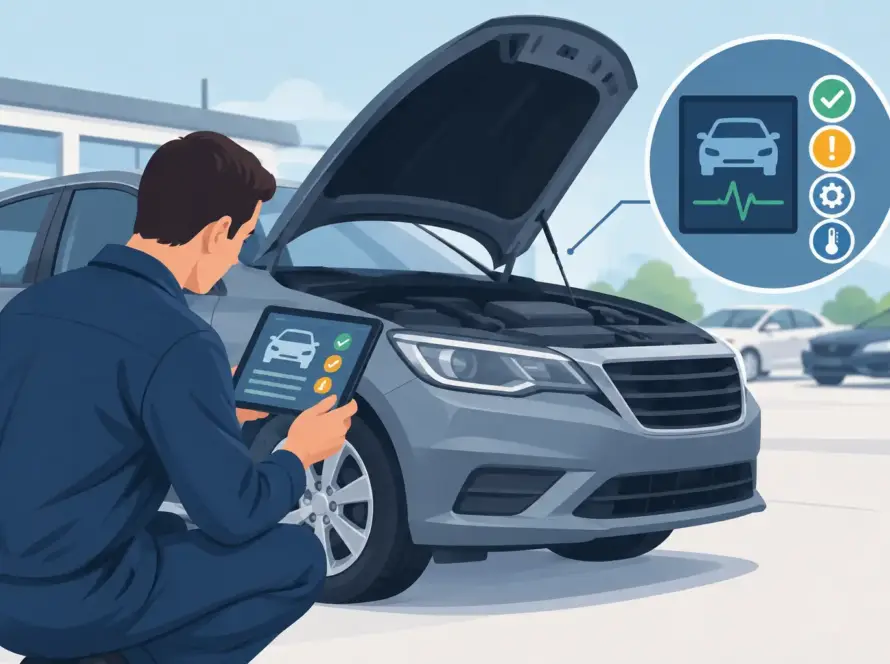
A private seller may tell you the car has been “perfect,” “lady driven,” or “only used for short trips.” Those claims may be honest, but they are not evidence. A pre purchase inspection private seller appointment gives you independent evidence before your money changes hands – and before a hidden fault becomes your problem.
Private-sale cars can be excellent value in the UAE. You may find a well-kept SUV with a complete service record, a low-mileage luxury car, or an enthusiast-owned vehicle that has received genuine care. You can also find repaired accident damage, overheating issues, warning lights that were recently cleared, worn suspension, flood exposure, and costly maintenance waiting just beyond the test drive.
The seller owns the car. Their view of its condition is naturally different from yours. Your job is not to accuse them of hiding something. Your job is to verify what you are buying.
Why a CarChecker.ae pre purchase inspection for a private seller matters
Buying directly from an owner often feels more personal than buying from a dealership. You can ask how the car was used, see their paperwork, and hear their story. That can be useful context, but it should never replace a technical assessment.
A car can drive smoothly for 20 minutes and still have serious issues. Transmission hesitation may only appear when the fluid is hot. A weak battery or charging system may not show itself until the next morning. Oil leaks can be cleaned before a viewing. Paintwork can look excellent under evening lights while hiding repaired panels and inconsistent gaps.
A proper inspection looks beyond first impressions. It checks whether the vehicle’s mechanical condition, electronic systems, structure, maintenance history, and road behavior support the asking price. It also gives you a clear basis for a decision: buy with confidence, renegotiate based on real repair needs, or walk away.
That decision can save far more than the cost of an inspection. On a vehicle priced at AED 60,000, a missed transmission fault, AC repair, or accident-related chassis issue can quickly cost thousands. On a premium or performance car, the financial exposure can be much higher.
What an independent inspection should examine
A meaningful private-sale inspection is not a quick walk-around and a scan for dashboard fault codes. It should assess the car as a complete system, because problems often connect. Uneven tire wear, for example, can point to alignment issues, worn suspension components, or previous impact damage.
Mechanical condition and road behavior
The engine should be checked for leaks, unusual noises, smoke, cooling concerns, fluid condition, and signs of poor repair work. The inspector should also assess the transmission, steering, suspension, brakes, exhaust, and drivetrain.
A road test is where many concerns become clearer. Brake vibration, steering pull, gearbox shift quality, wheel-bearing noise, suspension knocks, engine temperature, and vibration under acceleration may not be obvious while the car is parked. A seller may say, “It has always been like that.” An experienced inspector can help distinguish a normal characteristic from a repair risk.
Diagnostics, electronics, and safety systems
Modern vehicles store valuable information in their control modules. Computer diagnostics can identify active faults, stored fault codes, sensor issues, charging-system problems, and concerns involving engine management, transmission, airbags, ABS, parking sensors, cameras, and driver-assistance features.
A clean dashboard is not always a clean car. Warning lights can be reset before a viewing, and some faults return only after the vehicle is driven through a complete cycle. Diagnostic findings should be considered alongside the physical inspection and road test, not treated as a standalone answer.
Bodywork, structure, and underbody
The exterior tells part of the car’s story. Paint-depth readings, panel alignment, overspray, inconsistent finishes, replaced fasteners, and uneven gaps can reveal previous repairs. Not every repaired panel makes a car a bad purchase. A minor cosmetic repair completed to a high standard is very different from poorly repaired collision damage.
The key question is the extent and quality of the work. Structural concerns, chassis damage, compromised mounting points, corrosion, or underbody impact damage deserve particular attention. These issues can affect safety, tire wear, handling, resale value, and the vehicle’s long-term reliability.
An underbody inspection matters in the UAE, where a clean-looking car may still have damage from curbs, road debris, off-road use, or previous accidents. You cannot make a sound decision if you only inspect what is visible at eye level.
Interior, maintenance, and vehicle history
Interior wear should make sense for the odometer reading. A heavily worn steering wheel, driver’s seat, pedals, or switchgear does not automatically prove mileage concerns, but it is worth investigating when it does not match the stated use of the car.
Service records are equally useful when they are consistent and specific. Look for dates, mileage, workshop details, and evidence of major scheduled work. A stamped book without supporting invoices is better than nothing, but it does not prove every maintenance claim. If the car is due for tires, brakes, a battery, fluid service, or a major manufacturer interval, those costs belong in your purchase calculation.
Vehicle-history checks can add another layer of protection by identifying concerns connected to accident records, ownership, mileage, or import status. For UAE buyers, this is especially valuable with vehicles that may have moved between emirates or entered the country from another market.
How to handle the private seller inspection appointment
A reasonable seller should understand why you want an independent inspection. You are not asking them to guarantee a used car forever. You are asking for access to verify its current condition before you commit.
Arrange the inspection at the vehicle’s location where possible. A fully mobile service avoids the practical problem of asking a seller to spend half a day at a workshop, and it allows the car to be assessed where it is available. Confirm that there is enough time for a complete evaluation, including a road test if conditions permit.
Before the appointment, ask the seller to have the registration, service records, spare key, and any repair invoices available. Be direct about known concerns. If they mention a recent repair, do not assume it is a negative. Bring it up so the inspector can verify the work and check whether related issues remain.
Do not send a nonrefundable deposit simply because other buyers are interested. If you do need to reserve the vehicle, make the arrangement clear in writing and keep the amount proportionate to the risk. A seller who refuses any independent inspection, rushes you to pay immediately, or will not provide basic documentation is giving you useful information about the transaction.
How to use the inspection report
The value of an inspection is not a pass-or-fail label. Used cars have wear. Even a well-maintained vehicle may need tires, brakes, a battery, or routine service soon. The report should help you separate normal ownership costs from safety concerns, undisclosed damage, and repairs that materially change the deal.
Review the findings in three groups. First, identify urgent safety or structural issues. Second, calculate near-term repairs and maintenance. Third, note cosmetic items and minor observations that may affect value but do not necessarily make the car unsuitable.
Then compare the total expected cost with the asking price and with similar vehicles in the market. If the car needs AED 8,000 in immediate work, a small discount may not be enough. If the condition is strong and the seller has priced it fairly, the report can give you the confidence to proceed without second-guessing every detail.
CarChecker.ae brings this independent assessment to the car’s location across the UAE, with one comprehensive inspection package rather than confusing service tiers. You receive documented findings, photos and videos where relevant, and plain-English guidance on what those findings mean for your decision.
The best private-sale purchase is not necessarily the cheapest car or the cleanest-looking one. It is the car whose condition you understand, whose risks you have priced honestly, and whose seller has given you enough room to inspect before you invest.