A used EV can look flawless, drive quietly, and show a full charge on the dashboard while carrying an expensive problem beneath the floor. A CarChecker.ae electric car battery health test looks beyond the displayed range to assess the condition of the component that matters most: the high-voltage battery.
For a buyer in the UAE, this is not a small detail. Heat, charging habits, long-distance use, accident history, and poor maintenance can all affect an electric vehicle’s battery system. Before you transfer money, you need independent evidence of what you are buying – not a seller’s assurance that the car “charges fine.”
What a CarChecker.ae electric car battery health test actually checks
Battery health is often reduced to one number: state of health, or SOH. This figure estimates how much usable energy the battery retains compared with when it was new. A battery with 90% state of health, for example, should generally hold less energy than it did when new, but it may still be perfectly suitable for daily driving.
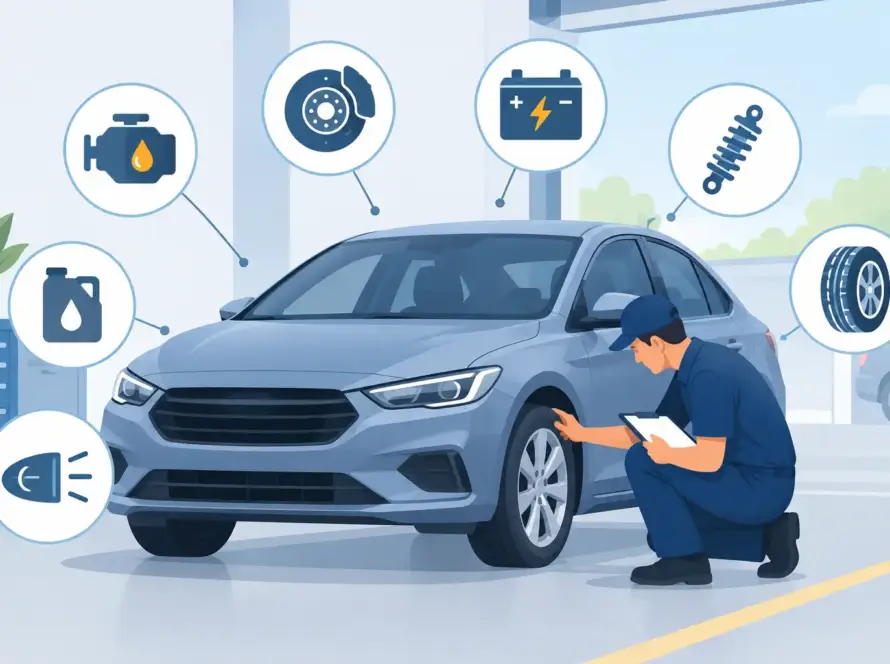
That number matters, but it is not the whole story. A proper electric car battery health test also considers whether battery modules are behaving consistently, whether individual cells show unusual voltage differences, and whether the battery management system has logged faults. It should examine the charging system, high-voltage components, thermal management, and any warning codes that may not be visible on the instrument cluster.
The goal is straightforward: establish whether the EV’s real-world usability and potential repair exposure match its price and the seller’s description.
State of health is useful, not absolute
Different manufacturers calculate state of health differently. Some make detailed battery data easier to access than others, and the figure can be influenced by battery temperature, recent charging, driving conditions, and software updates. That means a health percentage should be interpreted in context, not treated as a pass-or-fail verdict by itself.
A lower figure is not automatically a reason to walk away. An older EV with sensible mileage, predictable range, no diagnostic faults, and a price that reflects its battery condition may still be a good purchase. On the other hand, a relatively high health figure does not cancel out fault codes, inconsistent module readings, charging errors, or accident damage near the battery pack.
Why the dashboard range is not enough
The range shown in an EV is an estimate based on recent driving behavior, climate-control use, speed, road conditions, and battery charge. A seller who has driven gently around town may show an optimistic range figure that does not reflect highway driving in UAE heat.
Range can also be affected by more than the battery. Underinflated tires, brake drag, weak air-conditioning performance, wheel alignment issues, and software settings all influence consumption. That is why an inspection should combine battery diagnostics with a road test and a broader mechanical assessment.
During the road test, an inspector can look for abnormal power delivery, warning messages, regenerative-braking concerns, unusual noises, excessive energy consumption, and cooling-system behavior. The car should feel consistent under acceleration and deceleration. Hesitation, restricted power, charging warnings, or a sudden drop in indicated range deserve further investigation.
UAE heat makes battery checks more valuable
Electric vehicle batteries operate best within controlled temperature ranges. Modern EVs use cooling and heating systems to protect the pack, but extreme ambient temperatures place greater demand on those systems. In the UAE, a problem with battery cooling may become much more serious during summer use.
A battery health assessment should therefore include the thermal-management system where accessible. The inspection may identify fault codes related to coolant pumps, fans, valves, sensors, or battery-temperature regulation. It should also check for leaks, damaged underbody shields, and evidence of impact around the battery enclosure.
Parking habits and charging behavior matter too. Frequent exposure to high temperatures at very high charge levels can be harder on some battery chemistries than moderate daily charging. Fast charging is not inherently harmful, but repeated high-power charging combined with heat and heavy use can contribute to wear over time. The vehicle’s age, model, battery chemistry, mileage, and use pattern all need to be considered together.
Battery damage is not always visible
The high-voltage battery is protected beneath the vehicle, which makes a visual check from above impossible. A proper pre-purchase inspection needs underbody access and a careful chassis assessment. Damage to battery covers, mounting points, cooling lines, wiring, or protective shields can indicate a hard impact, poor repair, or off-road contact.
This matters because battery-pack repairs can be complex and expensive. Even when an EV drives normally, previous structural damage or signs of water intrusion can create questions about safety, insulation integrity, future reliability, and warranty coverage.
Inspectors should also look beyond the pack itself. The charge port, charging flap, high-voltage cables, inverter area, onboard charger, DC-DC converter, and 12-volt battery all play a role in dependable EV ownership. A weak 12-volt battery, for example, can cause confusing electronic warnings that buyers may incorrectly blame on the main traction battery.
What diagnostic results should make you pause?
A single stored code is not always a disaster. Some codes are historic, intermittent, or linked to a known issue that has already been repaired. What matters is whether the code is active, recurring, safety-related, or supported by other signs during the inspection.
You should pause when diagnostics reveal active high-voltage faults, charging-system errors, isolation warnings, major imbalance between battery modules, cooling-system faults, or a pattern of battery-related alerts. Evidence of underbody impact, water damage, unauthorized modifications, or incomplete repairs should also be treated seriously.
Ask for findings in plain English. A useful report does not simply list technical codes. It explains what was found, why it matters, what further testing or repair may be needed, and whether the issue changes the purchase decision or negotiating position.
How to prepare the EV for inspection
The condition of the car on inspection day can affect what can be tested. Ideally, the vehicle should arrive with enough charge for diagnostics and a road test, usually well above the low-battery warning level. The seller should provide both charging cables, charging adapters, keys, service records, and any available battery-warranty documents.
If possible, ask the seller not to erase warning messages or disconnect the 12-volt battery before the appointment. Doing so can remove useful clues or temporarily hide faults. Recent rapid charging is not automatically a problem, but the inspector should know when and how the car was last charged.
A vehicle-history review is equally valuable. Confirm whether the EV has been in an accident, imported from another market, subject to recalls, or repaired after flood exposure. Imported EVs may have different charging hardware, software settings, warranty terms, or parts availability than UAE-specification vehicles.
Use the result to make a smarter offer
The best outcome of a battery inspection is not necessarily a perfect score. It is clarity. If the battery condition is healthy, charging equipment works correctly, the underbody is sound, and diagnostic results are clean, you can proceed with greater confidence.
If the test identifies manageable wear, use that evidence to negotiate a price that reflects the remaining range and future ownership risk. If it identifies high-voltage faults, damage, or uncertain repair history, walking away can save far more than the cost of an inspection.
For used EV buyers, a complete pre-purchase inspection should not stop at battery data. CarChecker.ae combines our exclusive EV battery and charging-system assessment for which we are the exclusive providers in the entire Middle East, with diagnostics, chassis checks, underbody inspection, road testing, vehicle-history review, and photo- and video-supported reporting at the vehicle’s location. We’re on your side when the seller’s description needs independent verification.
The right used EV is not simply the one with the lowest mileage or the most impressive range figure. It is the one whose battery condition, charging system, repair history, and price all make sense together. Inspect before you invest, then buy with your eyes open.